Short answer
Asbestos tile removal means a licensed contractor lifting the tile whole and wet, then removing the black mastic beneath it — never sanding or grinding either. Intact tile can often be covered instead. Testing decides which, because tile and mastic are tested separately.
If your Salinas home or commercial building still has those 9-inch by 9-inch floor tiles — in a kitchen, hallway, laundry room, or under the carpet you’re about to pull up — you’re looking at the single most recognizable marker of the vinyl-asbestos flooring era. The tiles themselves commonly contain asbestos, and the black adhesive (mastic) underneath them frequently contains it too, even when the tile doesn’t.
This page explains how to tell whether your flooring is a problem, what the law requires before anyone disturbs it, what removal involves, and what it typically costs in the Salinas area.
Why 9×9 Tiles Are the Classic Warning Sign
From roughly the 1950s through the early 1980s, vinyl-asbestos tile (VAT) was one of the most popular flooring products in America — durable, cheap, and easy to install. The 9×9 format was the dominant size of that era, which is why it functions as a visual shorthand for “test before touching.” Some 12×12 tiles from the same period also contain asbestos, so size alone doesn’t clear a floor.
Dating a floor by what you can see
Nothing visible proves or disproves asbestos — only a lab result does that. But the combination of tile size, adhesive colour, and building age tells you how suspicious to be, and therefore how much of the floor to sample:
| What you’re looking at | Typical era | How suspect |
|---|---|---|
| 9×9 tile, black or dark brown mastic | Roughly 1950s–early 1960s peak, in service far later | Highest — treat as asbestos until tested |
| 12×12 tile in a pre-1985 building | 1960s onward; asbestos formulations continued into the 1980s | Suspect — size does not clear it |
| Sheet vinyl with a felt-like backing | Pre-1985 | Suspect — the backing is the usual asbestos layer |
| Black, tar-like “cutback” adhesive under any tile | Pre-1985 | Suspect independently of the tile above it |
| Tile installed after roughly the late 1980s | Post-1985 | Low, but a remodelled floor can hide older layers beneath |
The trap is a remodelled floor. A 1990s kitchen laid over a 1958 kitchen still has the 1958 flooring under it, and pulling up the newer layer is precisely the moment the older one gets broken up. In pre-1980 Salinas housing stock, assume layers until someone has looked.
Two separate materials matter here:
- The tile itself. Asbestos fibers were mixed into the vinyl as a binder and strengthener.
- The mastic underneath. “Cutback” adhesive — the black, tar-like glue used to set tile — commonly contains asbestos independently of the tile. A floor can have clean tile over asbestos-containing mastic, or the reverse.
That’s why a compliant test samples both layers. In older Salinas neighborhoods — the Alisal, older blocks near downtown, and much of the pre-1980 housing stock — multi-layer floors are common: sheet vinyl over tile over mastic, each layer needing its own analysis.
Is Asbestos Floor Tile Dangerous If I Leave It Alone?
Here’s the honest answer most contractors won’t lead with: intact, well-adhered vinyl-asbestos tile is generally considered a low-risk material. The asbestos is bound inside the vinyl matrix, and fibers aren’t released by walking on it or mopping it.
The risk profile changes completely when the tile is disturbed:
- Sanding, grinding, or bead-blasting old tile or mastic — the highest-risk activity, and a common step in slab preparation
- Breaking, chipping, or prying brittle tiles during demolition
- Dry-scraping mastic to prepare for new flooring
- Cutting into the floor for plumbing or electrical work
Every one of those releases fibers into the air of an occupied home. This is exactly the scenario asbestos regulations are written around: not the material sitting quietly, but a renovation crew turning it into dust.
Your Real Options: Remove, or Cover Over
If your tile or mastic tests positive, removal is not automatically the answer. There are two legitimate paths, and a trustworthy contractor will explain both:
Option 1 — Encapsulate (cover it)
Intact asbestos tile can often be left in place and covered with new flooring: floating floors, new underlayment, or certain glue-down products installed over a suitable barrier. This avoids abatement cost entirely and is a recognized, legal approach — the asbestos stays bound and undisturbed.
Encapsulation is usually not appropriate when:
- The tile is loose, broken, or water-damaged
- Floor height matters (door clearances, appliance fit, ADA transitions)
- You’re planning a future remodel or demolition anyway — you’re deferring the cost, not eliminating it, and the covering layer adds removal work later
- The subfloor needs repair that requires getting under the tile
Which path fits — the short version
| Your situation | Usually the right call |
|---|---|
| Tile intact, floor height not an issue, no remodel planned | Encapsulate |
| Tile cracked, curling, or water-damaged | Remove |
| Subfloor repair or plumbing work needed underneath | Remove |
| Selling soon, buyer plans to remodel | Test and document; let the buyer decide with facts |
| Full demolition planned within a few years | Remove — encapsulating first means paying twice |
| Mastic positive but tile clean | Still abatement work; the mastic governs |
Option 2 — Licensed removal
When removal is the right call, California law is specific: material containing more than 0.1% asbestos must be removed by a Cal/OSHA-registered, state-licensed asbestos abatement contractor. The pre-work survey documents what’s being removed and in what quantity, and above roughly 160 square feet of regulated material, MBARD and Cal/OSHA must be notified before work starts.
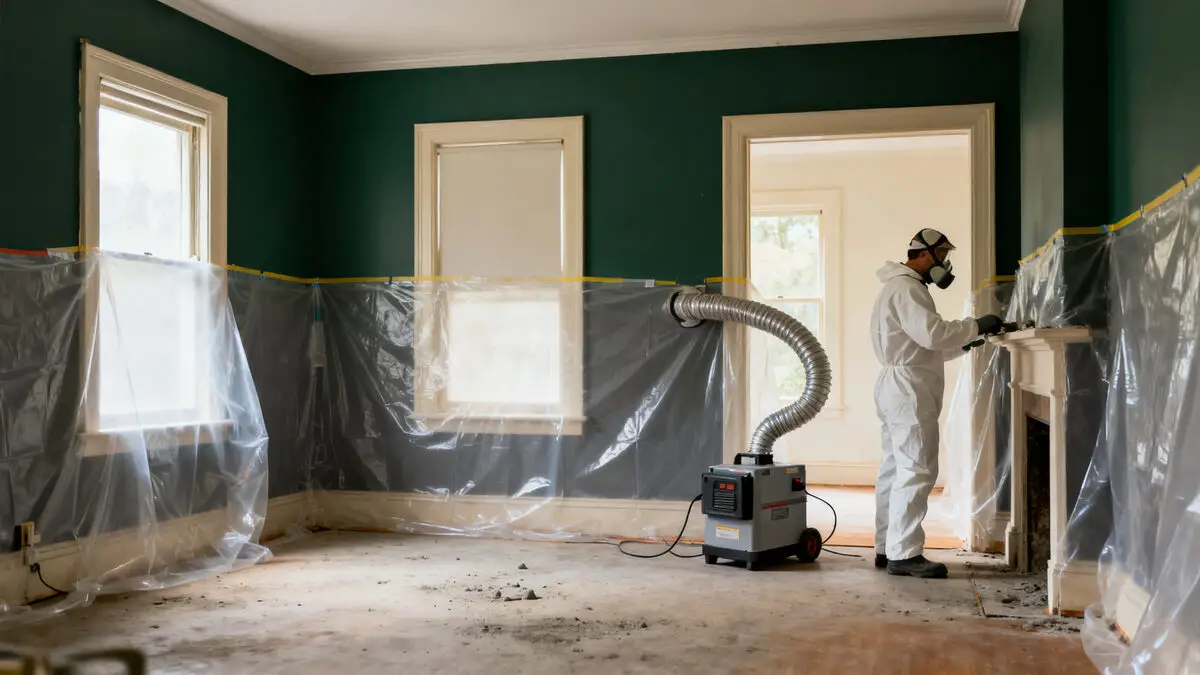
Professional tile and mastic removal looks like this:
- Containment. The work area is isolated with plastic sheeting and negative air pressure so fibers can’t migrate into the rest of the building.
- Wet methods. Tiles are removed whole where possible, kept wet to suppress dust. No sanding, no dry-scraping, no grinding.
- Mastic removal. Remaining adhesive is removed with wet scraping and solvent-based mastic removers — the step DIY attempts most often get wrong.
- Cleanup and disposal. HEPA vacuuming, wet-wiping, and disposal of the material as asbestos waste at an authorized facility, with a documented waste manifest.
- Clearance. The area is verified clean before containment comes down and your new flooring goes in.
What Does Asbestos Floor Tile Removal Cost in Salinas?
Flooring abatement is typically priced per square foot, and the honest range is wide because the work varies:
- Typical industry range: roughly $5–$15 per square foot for tile and mastic removal, depending on tile condition, whether mastic must be fully removed (required for some new floor types, not others), containment complexity, and disposal quantities.
- A single kitchen or hallway is commonly a four-figure project; whole-house flooring removal scales from there. For context on how flooring compares to other materials, see the Salinas asbestos removal cost guide.
- Testing first protects your budget. Lab analysis of tile and mastic samples costs a small fraction of abatement. If your floor tests clean, you’ve saved the entire abatement premium; if only one layer is positive, the scope — and price — narrows accordingly.
Be skeptical of any quote produced without lab results. Pricing “assumed asbestos” flooring means paying hazardous-material rates for material nobody has confirmed is hazardous.
What About the Tiles Under My Carpet?
A common Salinas-specific scenario: pulling up 1970s-era carpet in a pre-1980 home and finding 9×9 tile underneath. Stop before the next step. The carpet itself isn’t the issue — but tack strips, staples, and adhesive-bonded pad can damage brittle tile as they come out, and that’s a disturbance. Get the tile and mastic sampled before the flooring crew’s demo day, not after they’ve already started prying.
The same applies to any residential renovation where old flooring is in the work path — testing first is faster than a mid-project shutdown every single time.
Serving Salinas and Monterey County
We connect property owners in Salinas, Monterey, Seaside, Marina, Watsonville, Hollister, and throughout the MBARD district with certified professionals for flooring testing and licensed tile and mastic abatement — coordinated as one process, from first sample to clearance.