If you’re pricing asbestos work in Salinas, here’s the honest headline: most residential removal projects in this area land between $2,078 and $4,157. Small, contained jobs can cost less. Whole-house abatement, commercial buildings, and badly deteriorated materials cost more. Every legitimate number starts with lab testing — because until you know which materials actually contain asbestos, every quote is a guess.
This guide breaks down typical local pricing by material, explains exactly what moves a project up or down within (or beyond) that range, and shows why the cheapest dollar you’ll spend is on testing first.
Typical Asbestos Costs in the Salinas Area
The table below shows typical local ranges by material. Treat these as planning numbers, not quotes — the price for your project depends on quantity, condition, and access, which is why testing and a scope walk-through come before any real bid.
| Service | Typical local range | Notes |
|---|---|---|
| Popcorn ceiling removal | $3–$7 / sq ft | Test first — post-1980 ceilings often contain no asbestos |
| Floor tile & mastic removal | $5–$15 / sq ft | Tile plus black mastic adhesive; both need testing |
| Pipe & duct insulation | Priced per linear foot + access | Most hazardous category; crawl-space access drives cost |
| Cement-asbestos (transite) siding | Often mid four figures per house | Panel condition and disposal volume drive the price |
| Pre-demolition / renovation survey | Several hundred to low four figures | Residential at the low end; commercial scales with samples |
A few notes on reading that table:
- Per-square-foot rates compound quickly. A 1,200 sq ft popcorn ceiling at $3–$7/sq ft is a $3,600–$8,400 project — but most homes only need specific rooms treated, which is how so many jobs stay inside the typical range.
- Minimum charges exist. Licensed abatement requires containment setup, protective equipment, negative air, and disposal no matter how small the job — so even a tiny removal rarely comes in under four figures once mobilization is counted.
- The survey is the smallest line item on the whole project. Several hundred dollars against a four-figure abatement decision.
- Flooring is the one line where a cheaper option genuinely exists. Intact tile can often be covered rather than removed, which takes the abatement cost off the project entirely — see asbestos floor tile and mastic removal for when encapsulation is appropriate and when it just defers the bill. Note that the tile and the black mastic under it are tested separately, and either one can be the reason a floor is priced as abatement.
What Moves the Price
Two Salinas homes on the same street can get very different abatement quotes. These are the factors that actually drive the difference:
Quantity of material
Abatement is priced substantially on volume: square feet of ceiling or flooring, linear feet of pipe insulation, number of waste bags leaving the site. A survey that measures quantities precisely — rather than eyeballing — is what turns a padded quote into a tight one.
Friability and condition
Friable material (crumbles under hand pressure — old pipe lagging, degraded popcorn ceiling) releases fibers far more readily than non-friable material like intact vinyl tile. Friable and damaged materials demand stricter containment, more protective measures, and more careful handling, all of which raise cost. Ironically, well-bonded material in good condition is both safer and cheaper to remove.
Containment complexity
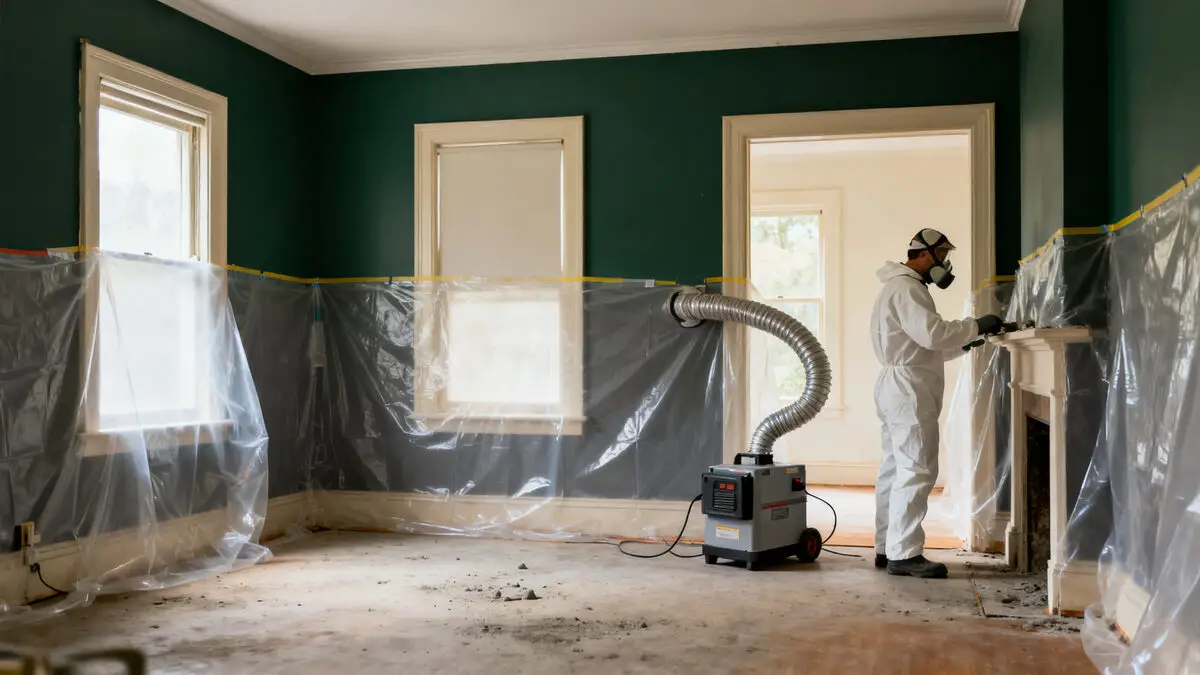
Every removal area gets sealed with plastic sheeting under negative air pressure. One bathroom is a simple containment; a hallway ceiling connected to five rooms is not. Open floor plans, tall ceilings, and occupied homes all add setup time and cost.
Access
Pipe insulation in a tight crawl space or attic takes multiples of the labor that the same footage takes in an open basement. Second-story exterior siding needs staging. Access is the quiet variable that explains many “why is this quote higher?” conversations.
Disposal and transport
Asbestos waste must go to a landfill authorized to accept it, manifested and sealed. Disposal fees scale with volume and are a real, unavoidable line item on every honest quote from the Salinas area.
Clearance testing
After removal, third-party air sampling verifies the area is safe to reoccupy. It’s a modest cost that protects you — and its absence from a bid usually signals the rest of the bid is cutting corners too.
Why Testing First Saves Money
It seems backwards that adding a step saves money, but it does — consistently:
- Testing rules materials out. In practice, plenty of suspect materials come back clean — post-1980 ceiling texture, newer flooring layers, some plasters. Every clean result removes an entire line item from the abatement scope.
- Skipping the survey means paying “assume it’s all asbestos” prices. The regulatory alternative to testing is treating every suspect material as asbestos-containing and handling it under full abatement procedures. That’s the most expensive possible version of your project.
- Measured scopes get tighter bids. Contractors pad quotes to cover unknowns. A lab report with exact materials and quantities removes the unknowns — and the padding.
- A survey prevents the four-figure surprises. Discovering asbestos mid-renovation stops the job, adds emergency abatement at premium pricing, and can add cleanup of the area that was disturbed. The several-hundred-dollar survey exists precisely to prevent that scenario.
Getting a Real Number
Ranges are for planning; your project deserves a real quote. The path there is short: a certified professional tests the materials in question, the lab confirms what’s actually asbestos, and a licensed abatement contractor prices the confirmed scope — quantity, containment, access, disposal, clearance. That’s the number you can budget against, and the one we can start for you today.