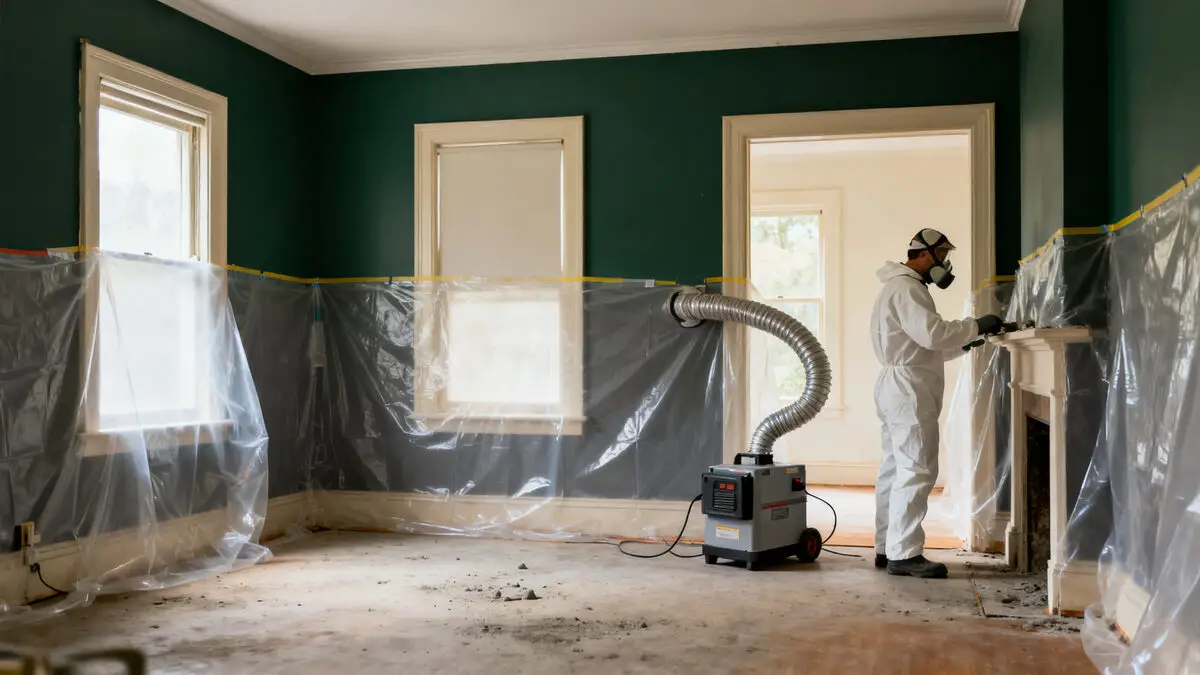
The textured “popcorn” ceilings in thousands of Salinas homes date from an era — roughly the 1950s through the 1980s — when acoustic spray-on texture routinely contained asbestos. Homeowners want them gone for good reasons: they date the house, they catch dust, they’re hard to paint, and they can hide damage. But there’s a right order of operations, and it starts with a laboratory test, not a scraper.
Here’s how to find out what’s actually on your ceiling, what the law requires in Salinas, and what removal really costs in both scenarios — asbestos and no asbestos.
Why Popcorn Ceilings Are an Asbestos Concern
Acoustic ceiling texture was one of the most common asbestos-containing building products in American homes. Asbestos made the texture fire-resistant, sound-deadening, and easy to spray. Its use in ceiling texture was banned in the late 1970s, but existing inventory was legally installed for years afterward — which is why ceilings from the early-to-mid 1980s still test positive with some regularity.
Salinas is full of exactly the housing stock where this shows up: postwar neighborhoods, ranch homes from the 1960s and 70s, and additions textured to match older ceilings. If your ceiling went up before about 1990, treat it as suspect until a lab says otherwise.
You cannot tell by looking. Asbestos texture and asbestos-free texture are visually identical. The only answer is a sample under a microscope — our asbestos testing page explains the PLM lab process.
Test First: The Rule and the Economics
Testing a popcorn ceiling is fast and cheap: a professional collects small samples using wet methods, an accredited lab runs Polarized Light Microscopy analysis, and you have your answer in a few business days. Two outcomes:
- Negative. Congratulations — your project just became an ordinary drywall job. Any competent drywall or painting contractor can scrape, skim, and refinish, with no special regulation involved.
- Positive. The texture must come down under containment, by a licensed abatement contractor. It costs more, but you’ll know the exact scope — and you avoided turning your living room into a contamination incident.
Either way, a few hundred dollars of testing controls a four-figure decision.
Why an Asbestos Ceiling Is Never a DIY Scrape
Dry-scraping is the worst-case disturbance for asbestos texture: it grinds friable material into dust directly over your head, and that dust settles into carpet, ductwork, and furniture where it keeps getting re-suspended. Beyond the exposure risk, there’s the legal line: California requires any disturbance of material containing more than 0.1% asbestos to be performed by a Cal/OSHA-registered, state-licensed asbestos abatement contractor.
Improper removal doesn’t just risk your family’s health — it creates a contaminated property that costs far more to clean up than professional abatement would have cost in the first place, and it exposes you to liability if you later sell the home.
How Professional Popcorn Ceiling Abatement Works
A licensed crew removing an asbestos ceiling follows a controlled sequence:
- Containment. The room is sealed with plastic sheeting, floors and fixtures protected, and the work area placed under negative air pressure with HEPA filtration so fibers can’t migrate into the rest of the house.
- Wet removal. The texture is thoroughly wetted — wet fibers don’t go airborne — and scraped from the ceiling in a controlled, systematic pass.
- Cleanup and disposal. All debris is double-bagged as asbestos waste and transported to an authorized disposal facility, with the waste manifest documenting the chain of custody.
- Clearance. The area is HEPA-vacuumed and wiped down, and the containment comes down only when the space meets clearance criteria.
Most single-room and whole-house ceiling projects finish in one to a few days, and you receive documentation of both the removal and the disposal.
What Does It Cost in Salinas?
For ceilings that contain asbestos, professional removal in the Salinas area typically falls in the range of $3–$7 per square foot — where your project lands depends on ceiling height, room complexity, furniture and flooring protection, and disposal volume. A typical bedroom is often in the low thousands; larger open-plan areas scale up from there. That’s consistent with the broader local range for residential abatement projects — see our Salinas cost guide for how ceiling work compares with flooring, insulation, and full-survey costs.
For ceilings that test clean, conventional scrape-and-refinish work is dramatically cheaper — a fraction of abatement pricing, since no containment, specialized disposal, or clearance testing is involved.
After the Popcorn: Finishing Options
Once the texture is gone (by either path), the ceiling needs a finish: a smooth skim coat is the most popular modern look, while knockdown or orange-peel textures cost less to apply over imperfect drywall. If your ceiling tested positive but is in good condition, encapsulation — new drywall installed directly over the old ceiling — can also be a sensible middle path that leaves the asbestos undisturbed and documented.
What to Expect While the Work Happens
Practical questions homeowners ask once a project is scheduled:
- Do we have to move out? Usually not for a single-room or few-room project — the containment isolates the work area, and the rest of the house stays livable. Whole-house ceiling abatement is often sequenced room-by-room, or scheduled while the home is empty during a remodel or before move-in, which is also when the work is cheapest and fastest.
- What about furniture and flooring? Anything that can leave the room should; everything else is sealed under plastic inside the containment. Tell the crew about anything irreplaceable.
- HVAC? The system serving the work area is shut off and its vents sealed so the containment’s negative air pressure does its job — fibers never get a path into the ductwork.
- What paperwork do I keep? The lab report, the abatement contractor’s license information, the waste disposal manifest, and the clearance documentation. Together they’re your proof — for a future buyer, appraiser, or contractor — that the ceiling was handled correctly.
Serving Salinas and All of Monterey County
From Alisal to North Salinas and across Monterey, Seaside, Marina, Watsonville, and Hollister, we connect homeowners with certified professionals for ceiling testing and licensed removal — one call gets your ceiling sampled and your project scoped honestly.