The Salinas Valley’s commercial building stock tells the story of its agricultural economy: packing houses and coolers near the rail lines, equipment barns and pump houses on ranch land, warehouses and storefronts from every era of the city’s growth. Many of these structures went up in decades when asbestos was a standard industrial material — which means renovation, re-roofing, or demolition projects here routinely trigger asbestos requirements that owners don’t find out about until a permit stalls.
This page covers what commercial and agricultural buildings in the Salinas area commonly contain, the compliance steps MBARD and Cal/OSHA require, and how abatement fits into a real project timeline.
Why Commercial and Ag Buildings So Often Contain Asbestos
Asbestos earned its place in industrial construction for the same reasons it’s now regulated: it’s durable, fire-resistant, and cheap. In commercial and agricultural structures built before the 1980s, the materials most often flagged in surveys include:
- Cement-asbestos (“transite”) panels — rigid gray board used for siding, roofing, and interior partitions on ag and industrial buildings; it shrugs off weather and fire, which is exactly why it’s still standing on so many structures today.
- Built-up and corrugated roofing — roofing felts, mastics, and corrugated cement-asbestos sheets.
- Thermal system insulation — pipe wrap, boiler lagging, and duct insulation in coolers, boiler rooms, and processing areas; the most hazardous category when it deteriorates.
- Floor tile, mastic, and ceiling systems — in offices, break rooms, and storefronts attached to industrial space.
- Stucco, plaster, and joint compound — throughout older mixed-use and commercial buildings.
These materials are commonly found in structures of this era — but “commonly” is not “certainly.” The inventory for your building comes from testing and inspection, not assumptions, and testing routinely narrows the abatement scope to a fraction of the building.
The Compliance Path: Survey First, Then Notification
For commercial work in Salinas, asbestos compliance is a sequence, and getting it out of order is what stops projects.
Step one is always the survey. MBARD requires an asbestos survey before renovation or demolition on any building — there is no age cutoff, and for regulated properties the survey must be performed under a California Certified Asbestos Consultant (CAC) and meet MBARD’s report standards. The full requirements are on our pre-demolition survey page.
Step two is notification. Because commercial buildings hold large quantities of material, projects here cross the notification thresholds far more often than residential jobs. Notifications spell out dates, quantities, methods, and contractors — and they have lead times. Building them into your schedule up front is the difference between a project that flows and one that sits waiting on paperwork.
Step three is the work itself, performed by Cal/OSHA-registered, state-licensed abatement contractors. Cal/OSHA adds the worker-safety layer: registration, exposure monitoring, trained and medically cleared crews, and defined work practices. Owners should care about this layer even though it regulates the contractor — under the federal asbestos NESHAP, responsibility runs to owners and operators, not just the crew doing the removal.
Planning Abatement Around a Working Facility
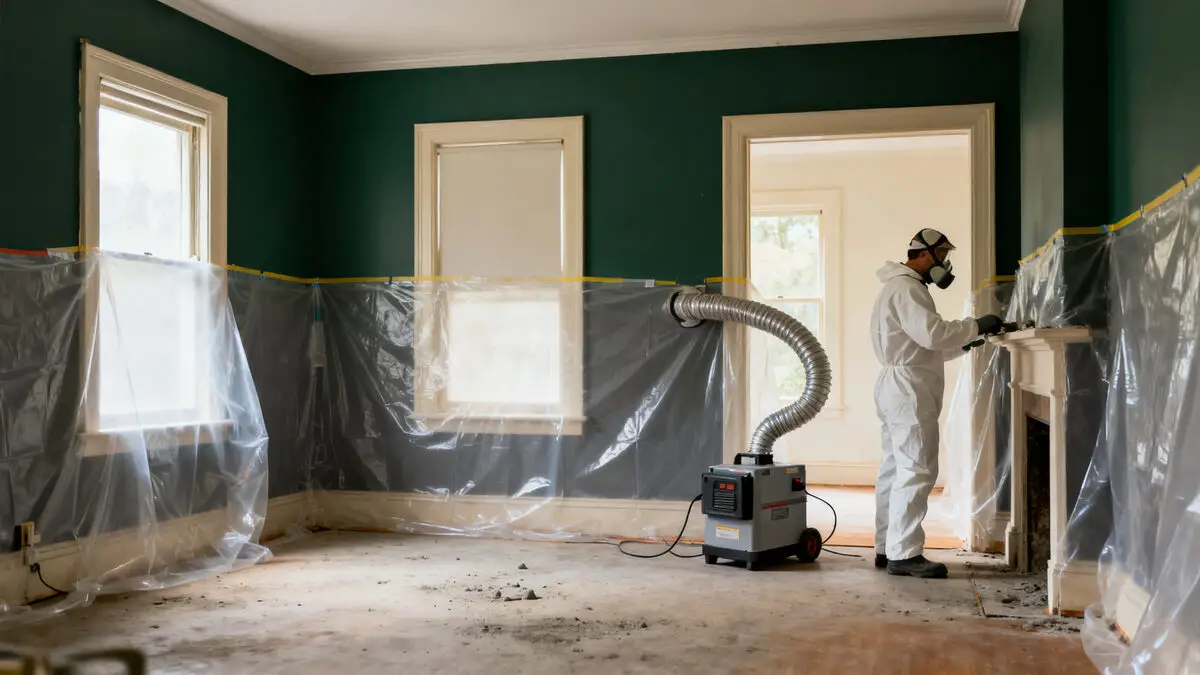
Most commercial abatement in the Salinas area doesn’t happen in empty buildings. Packing and processing schedules, tenant operations, and harvest timing all constrain when work can happen. The standard tools:
- Phased containment — sealing and clearing one zone at a time so the rest of the facility operates normally.
- Negative-pressure enclosures — containment under negative air keeps fibers inside the work zone, verified by air monitoring.
- Off-hours and seasonal scheduling — nights, weekends, and off-season windows for work in occupied or production-critical areas.
- Coordinated demolition handoff — abatement completed and cleared zone-by-zone so demolition or construction crews follow immediately behind.
Raising these constraints at the survey stage means the abatement plan is built around your operation instead of interrupting it.
Documentation: What You Should Hold When the Job Is Done
Commercial abatement produces a paper trail, and owners should insist on all of it — it’s what protects you in a sale, a refinance, a tenant dispute, or an MBARD inspection years later:
- The survey report identifying every sampled material and its lab result, which must also remain on site during the work itself.
- Copies of the MBARD (and, at threshold quantities, Cal/OSHA) notifications filed before work began.
- Waste manifests documenting that asbestos waste reached a landfill authorized to accept it — the disposal chain is the owner’s liability, not just the contractor’s.
- Clearance results from air sampling after removal, showing each zone was verified before reoccupation or demolition handoff.
Buyers’ environmental consultants and lenders ask for exactly these documents during due diligence on older commercial and ag properties. A complete file turns “there was asbestos here once” from a red flag into a closed item.
What Commercial Abatement Costs
Commercial projects are priced from the survey’s material inventory: square footage and linear footage of each material, its condition, how accessible it is, the containment each area needs, and disposal volume. Small, contained commercial jobs start in the low four figures; large multi-material projects — a full packing house re-side, a boiler room with extensive insulation — scale well beyond that. Two things keep costs honest:
- A real survey. You pay to abate the materials that contain asbestos — not everything that looks suspicious. On large buildings, that distinction is worth real money. Our cost guide explains the price drivers in detail.
- Competitive, scope-matched bids. A firm material inventory lets contractors bid the same defined scope, so you’re comparing prices rather than guesses.
Serving the Salinas Valley and All of Monterey County
From packing houses and coolers in Salinas to commercial buildings in Monterey, Seaside, Marina, Watsonville, and Hollister, we connect owners and facility managers with certified, licensed abatement professionals who handle the survey, the notifications, and the work as one coordinated process — to the standard MBARD and Cal/OSHA require.