Of all the asbestos-containing materials found in Salinas-area buildings, thermal system insulation (TSI) — the wrap on old pipes, the packed “mud” at pipe joints, the insulation on ducts, boilers, and furnaces — is the category professionals treat with the most caution. Not because it’s the most common, but because it’s the most friable: soft, crumbly, and ready to release fibers at the lightest disturbance.
If you’ve found wrapped pipes in a basement, crawlspace, garage, or utility room of a pre-1980 building, this page explains what you’re likely looking at, why the rules around it are strict, and how safe removal actually works.
What Is Thermal System Insulation?
Before roughly 1980, asbestos was the default insulating material for anything that carried heat. In homes and commercial buildings around Salinas and Monterey County, it shows up as:
- Corrugated pipe wrap — white or gray, layered like cardboard, wrapped around steam and hot-water pipes
- Joint and elbow “mud” — plaster-like insulation cement packed around fittings, valves, and pipe elbows, often lumpy and hand-applied
- Block and blanket insulation — chalky panels or paper-faced wrap on boilers, furnaces, water heaters, and HVAC ducts
- Duct tape and paper — asbestos-paper wrap and fabric joint tape on older forced-air duct systems
You’ll find these in pre-1980 basements and crawlspaces, behind access panels, in older commercial mechanical rooms, and in the utility buildings of Salinas Valley agricultural operations.
Why TSI Is the Most Hazardous Category
Asbestos risk isn’t just about whether a material contains fibers — it’s about how easily those fibers get into the air. That property is called friability, and it’s the dividing line in how regulations treat materials.
A vinyl floor tile holds its asbestos inside a tough binder; it takes power tools to make it dangerous. Aged pipe insulation is the opposite: it can be crumbled by hand pressure. In practice, that means fibers can be released by:
- Brushing against a wrapped pipe while moving boxes in a basement
- A plumber cutting into a line for a repair
- Water damage or simple age causing the wrap to sag and shed
- Kids or pets getting into a crawlspace
Once released, fibers settle on stored belongings, framing, and ductwork — and disturbing those surfaces re-suspends them. This is why damaged TSI is the one asbestos scenario where “leave it alone and plan carefully” gives way to “keep people out of the space and get an assessment now.”
Never a DIY Job — Here’s Why the Law Draws the Line
California’s rule is blunt: disturbance of material containing more than 0.1% asbestos must be performed by a Cal/OSHA-registered, state-licensed asbestos abatement contractor. For friable TSI, there is no realistic gray area:
- The material fails the “careful homeowner” test. With floor tile, careful whole-tile removal at least limits fiber release. Deteriorated pipe wrap sheds fibers the moment it’s handled — there is no gentle way to strip it bare-handed.
- Contamination spreads invisibly. Without negative-pressure containment, fibers migrate through the building on air currents and clothing. What began as ten feet of pipe wrap becomes a whole-basement decontamination.
- The liability lands on you. Improper removal exposes your household or tenants to fiber inhalation and exposes you to serious legal and financial consequences — including disclosure obligations when you sell.
If a handyman or general contractor offers to “just pull that old wrap off” as part of another job, that’s your cue to stop the work. It’s exactly the disturbance an asbestos survey exists to catch before it happens.
How Licensed Removal Actually Works
Professional TSI abatement is methodical, and each step exists because of how this specific material behaves:
- Testing and scoping. Samples confirm asbestos content and lab analysis quantifies it. The scope — spot repair, section removal, or full-system abatement — is defined in writing, with notification filed when quantities require it.
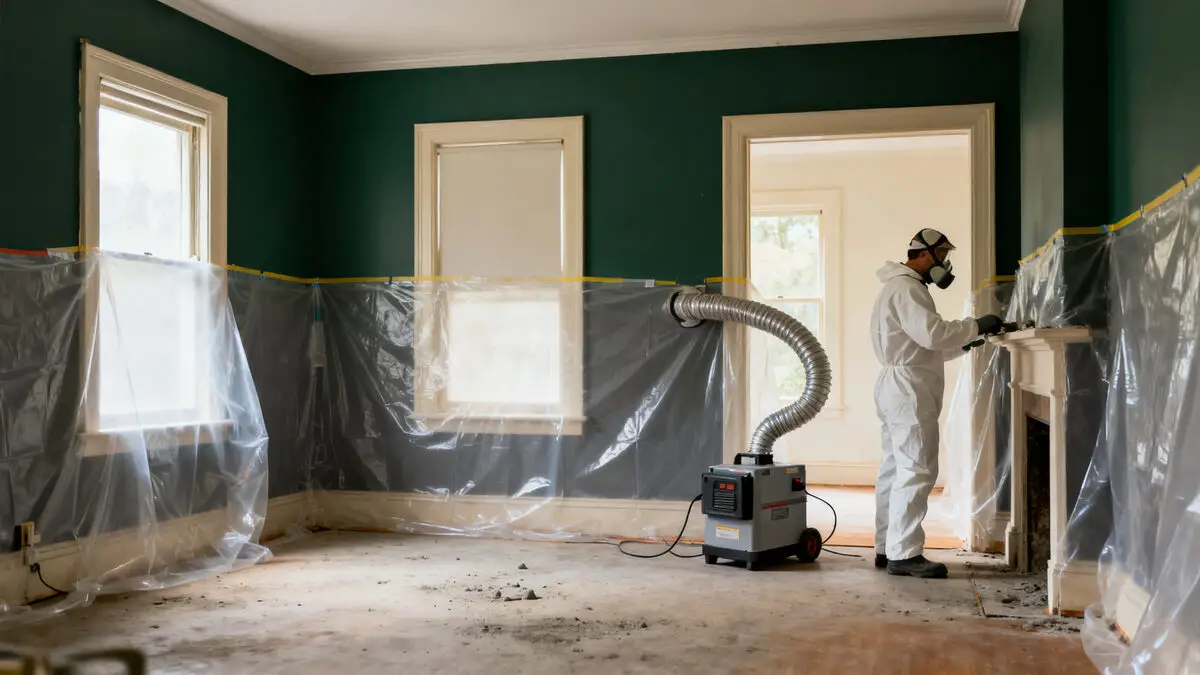
- Containment. The work area is sealed with plastic sheeting under negative air pressure with HEPA filtration. For pipe runs, contractors often use glovebag removal — a sealed plastic sleeve fitted around a pipe section, with built-in gloves, so insulation is stripped, bagged, and sealed without ever being open to the room’s air.
- Wet removal. Insulation is saturated with amended water (water plus surfactant) so it comes off as damp material, not dust.
- Cleanup and clearance. HEPA vacuuming and wet-wiping of all surfaces in containment, followed by visual inspection — and air clearance testing where the scope warrants it — before the containment comes down.
- Disposal. Sealed, labeled asbestos waste goes to an authorized disposal facility with a documented manifest.
Where insulation is in good condition and not in the path of upcoming work, a licensed contractor may instead recommend encapsulation or enclosure — sealing or boxing the material in place. It’s a legitimate, regulator-recognized option that costs less, and an honest assessment will tell you when it applies.
What Does Removal Cost in Salinas?
TSI abatement pricing is driven by three variables, and honest quotes reflect all of them:
- Linear footage — a spot repair at one damaged elbow versus a full basement’s pipe runs
- Access — open mechanical rooms price lower per foot than tight crawlspaces where workers move slowly in full protective equipment
- Notification and clearance scope — projects above the 260-linear-foot threshold carry notification requirements and typically more extensive clearance testing
Because those variables swing widely, per-project pricing without an inspection is guesswork. As reference points: small, contained repairs sit at the lower end of abatement pricing, while typical full removal projects in the Salinas area run in the low-to-mid four figures, with large or difficult-access TSI jobs above that. Testing plus a scoped estimate — both a small fraction of abatement cost — turn the guess into a number.
Serving Salinas and Monterey County
We connect property owners across Salinas, Monterey, Seaside, Marina, Watsonville, Hollister, and the wider MBARD district with Cal/OSHA-registered, licensed professionals for TSI assessment, repair, and removal — from a single damaged elbow in a crawlspace to full mechanical-system abatement in commercial and agricultural buildings.